




PRICING ISN’T ABOUT WHETHER YOUR HOME WILL SELL.

In most cases, it will…especially in the Conejo Valley

The real question is: are you bringing buyers in, or giving them a reason to move on?

  • Price it too high, and buyers skip it.
  • Price it too low, and you may never know what you could’ve gotten.

What you’re really trying to do is land in that range where the right buyers show up early, and you have some leverage.

That decision has a direct impact on how everything plays out once you hit the market.


My role is to help you figure out where that range is, so you don’t make a pricing decision that costs you later.

Estimating Your Home's Value

Zestimates: Where Most Sellers Start

I’m sure you’ve checked your home’s price estimate on Zillow and Redfin. That’s usually where most sellers start.

Those estimates can be helpful to establish a baseline, but none of these estimators have been inside your home. They don’t know about your remodeled kitchen or your landscaped yard.

You’ve probably seen how wide the estimated value can be, sometimes $100k or more for the same home.

Before I visit your home, I run it through every major pricing tool, both public and agent-only, to understand the range and how consistent (or inconsistent) those estimates really are.

I treat that range just as a starting point, nothing more. Over the years, I’ve done enough of these to know when they’re in line with the marketand when they’re not.

Comps: What they Tell You (and What They Don’t)

Comparable Listing and Sales: This is the traditional way we’ve established asking prices forever.

Every agent looks at the comps, but there are ways to make it more meaningful and effective.

  • Being an active agent in the Conejo Valley. Seeing homes in person across different price points gives a much better sense of what your home is competing against and what the value is.
  • Working with active buyers today helps you understand what’s actually driving decisions. Is it price? Condition? Are buyers cautious, or ready to move quickly?
  • Talking to agents who have recently sold or are currently selling in your area. Having long-term relationships with local agents often reveals things you won’t see in photos or listing descriptions.

In my experience, the combination of the price estimators and recent comps provide a solid basis for the value of your home.

Choosing the Right Pricing Strategy for Your Situation

Once I have a pretty good sense of your home’s value, I review these numbers with you when we meet at your home. It’s important to understand why you’re selling, your timeframe, and what kind of outcome you’re trying to achieve.

Together, we’ll determine an approximate market price and discuss what pricing strategy you’d like to take.

Your Pricing Options:

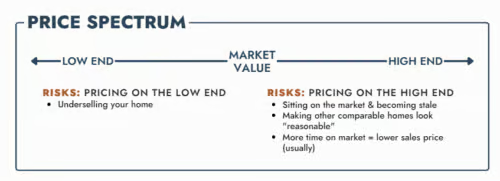
  • Pricing at the estimated price or slightly above: Safe, realistic, often the best option. Very little downside risk.
  • Slightly below estimated price: May drive activity and cause an auction-like environment that bids up the price above the estimated price and lead to a quick sale. Risk: You may only receive one offer potentially leaving money on the table.
  • Pricing well above estimated price: This is the “test the market” strategy and comes with the most risk. If it doesn’t sell, the risk is being ignored and becoming stale.

The asking price is ultimately your decision
. My job is to help you understand the trade-offs so you can make the right one for your situation.


CATCHING BUYERS ON THE FIRST WAVE

The Ready-to-Go Buyers

Here’s why pricing is so important: Your future buyer is already on Zillow and Redfin actively searching for a home like yours.

They know the market. They know what they’re looking for. They’re past the “getting familiar” stage. If it’s priced well, they come fast, they compare it to what they’ve already seen, and they decide quickly.

These are the first wave buyers we want to capture.

Catching that first wave increases your odds of getting multiple offers and a higher price.

The first wave usually lasts a couple of weeks. If those buyers passed after they saw your home, or didn’t come to see it at all, the market may be telling us we need to make an adjustment. That may be price, it may be condition, it may be both. It’s case by case.

Locally, I’ve seen this happen many times: A well-priced home in Westlake Village, Oak Park, and Thousand Oaks gets swamped over the first weekend and receives multiple offers. And then you’ll see a similar home just sit with little activity because the price is off. Same area. Same market. Different outcome.

The buyers are out there. Pricing correctly is what brings them to you in the first place.


CREATING A SECOND WAVE

Adjusting to Where the Buyers Are

If the first wave was missed, it’s time to reevaluate, adjust, and catch a second wave by:

Option 1

Waiting for a new batch of buyers to get past the “getting familiar” stage and become ready-to-go buyers, and hope they agree to the price.


Option 2

Reducing your asking price or improving your condition to attract a new wave of ready-to-go buyers and bring back the first wave for a second look.


Which is usually the smarter decision?
OPTION 2: Reduce Price/Improve Condition

Once a home has been on the market for several weeks, buyers start to wonder what’s wrong with it, even when nothing is. That perception is hard to shake.

A price reduction can reset things. While you’ll rarely get back to the initial excitement of a new listing, it’s the best strategy to get things moving again.


THE RISK OF HOLDING OUT FOR A CERTAIN PRICE IS HIGH


Some homes just take longer to sell depending on the neighborhood and price point, and that’s normal.

But if buyers aren’t coming through the door, price is usually the reason.

Not adjusting when needed can lead to:

  • Sitting on the market & becoming stale
  • Helping your competition by making other listings look “reasonable”
  • Less money in your pocket: More time on the market often leads to lower sales price.

My role is to help you determine whether it’s the price, or just the pace of the market, so you know when to hold firm and when to adjust.

CONEJO VALLEY GUY

For over 25 years, I’ve been helping homeowners sell in the Conejo Valley by thinking through pricing, preparation, timing, and the trade-offs that affect the final outcome.

My role is to help you make informed decisions and guide the process in a way that protects what you ultimately net.

THERE ISN’T ONE PERFECT NUMBER


There’s a range where a home could reasonably sell, and the right price sits somewhere within it.

The goal is to land in a spot that attracts the right buyers early and gives you the most leverage.

Figuring out where your home should land within that range is something I can only really do after I’ve seen it.

If you would like to talk through what your home might be worth, and how I’d approach pricing it based on your situation, I’m happy to take a look.

Contact Michael


Pricing doesn’t just affect how your home sells, it affects what you actually walk away with in the end.

If you haven’t looked at those numbers yet, it’s worth doing.

Estimate Your Costs to Sell

STEP 1:

IN-PERSON MEETING

We walk through your home, review the market & pricing, and decide what is or isn’t worth doing before listing.

STEP 2:

PREPARATION & LAUNCH

We get the home ready, finalize pricing, and bring it to market so it’s seen by active buyers.

STEP 3:

OFFERS → CLOSING

We review offers with a focus on what you’ll net, then move through negotiations, escrow, and closing with a clear plan.